
Aug 29
1842 The Treaty of Nanking: an unequal treaty ending the First Opium
War, was signed, forcing the Chinese Qing Dynasty to give control of the
island that is now the site of Hong Kong, and other concessions to the
British. [For further information, click here]
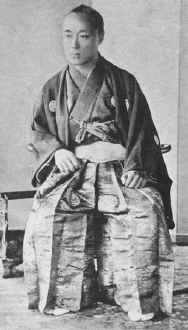
1866 Japan: Tokugawa Yoshinobu is appointed the 15th and last Shogun.
[See: Countdown to Infamy: Timeline to Pearl Harbor.]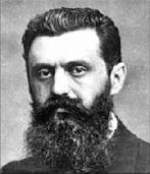
1897 The first Zionist Congress: was called by Theodor Herzl as a symbolic Parliament for those in sympathy with the implementation of Zionist goals . . . . The Congress took place in the concert hall of the Basel Municipal Casino on August 29, 1897 . . . .
The main items on the agenda were the presentation of Herzl's plans, the establishment of the World Zionist Organization and the declaration of Zionism's goals-the Basel program. In the version submitted to the Congress on the second day of its deliberations (August 30) by a committee under the chairmanship of Max Nordau, it was stated: "The aim of Zionism is to create for the Jewish people a home in Eretz Israel secured by law." To meet halfway the request of numerous delegates, the most prominent of whom was Leo Motzkin, who sought the inclusion of the phrase "by international law," a compromise formula proposed by Herzl was eventually adopted:
Zionism seeks to establish a home for the Jewish people in Eretz Israel secured under public law. The Congress contemplates the following means to the attainment of this end:
1. The promotion by appropriate means of the settlement in Eretz-Israel of Jewish farmers, artisans, and manufacturers.
2. The organization and uniting of the whole of Jewry by means of appropriate institutions, both local and international, in accordance with the laws of each country.
3. The strengthening and fostering of Jewish national sentiment and national consciousness.
4. Preparatory steps toward obtaining the consent of governments, where necessary, in order to reach the goals of Zionism.
At the Congress, Herzl was elected President of the Zionist Organization, and Max Nordau one of three Vice-Presidents. Thereafter, the Zionist Congress met every year (1897--1901), then every second year (1903-1913, 1921-1939). Since the Second World War, meetings have been held approximately every four years.
1914 World War I: Various:
Proclamation of General Baron von Bissing, German Military Governor of Belgium:
If a blinded and maddened population treacherously attacks and slaughters without pity the brave sons of our people who are facing death for their country, as well as the wounded, doctors and hospital nurses -- if bands of men endanger the safety of the lines of communication of the armies, self-preservation requires that extreme measures should immediately be adopted against them. Indeed, it is a sacred duty of the military commanders to take such measures. In such a case the innocent will have to suffer with the guilty. The repeated instructions of the command of our army have allowed no doubt to subsist as to this matter. It is no doubt to be regretted that in repressing these infamous acts it should be impossible to spare human lives, and that isolated houses as well as flourishing villages, and even entire towns, should be annihilated, but this should not provoke misplaced sentimentality. All that we may destroy is, in our eyes, less in value than the life of a single one of our brave soldiers. That is self-evident, and indeed, properly speaking, it is not necessary to mention it. Whoever speaks here of barbarity, commits a crime. Rigorously to carry out a duty is to obey a mandate of a high civilization [Kultur], and in that matter the population of the enemy's country has only to take a lesson from our army.
Women join British war effort:
On this day in 1914, with World War I approaching the end of its first month, the Women's Defense Relief Corps is formed in Britain.
Though women's rights organizations in Britain had initially opposed the country's entrance into the First World War, they reversed their position soon enough, recognizing the potential of the war effort to gain advancement for British women on the home front. As early as August 6, 1914, just one day after Britain declared war on Germany, an article published in the women's suffrage newspaper Common Cause stated that: "In the midst of this time of terrible anxiety and grief, it is some little comfort to think that our large organization, which has been completely built up during past years to promote women's suffrage, can be used to help our country through the period of strain and sorrow."
In addition to the two nursing organizations that existed in 1914—the First Aid Nursing Yeomanry (FANY) and the Voluntary Aid Detachments (VADs)—several new women's organizations sprung into being over the course of the war. Created with the support of the British secretary of state for war, Lord Horatio Herbert Kitchener, the Women's Defense Relief Corps came into being in late August 1914. The corps was made up of two divisions: a civil section, the goal of which was to substitute women for men in factories and other places of employment in order to free those men for military service; and a "semi-military" or "good citizen" section, where women were actively recruited for the armed forces. This latter group was trained in drilling, marching and the use of arms; its members were exhorted to protect not only themselves but their loved ones on the home front in case of possible invasion by the enemy.
Another organization founded during World War I was the Women's Army Auxiliary Corps (WAAC), created in July 1917. Members of the WAAC supported the war effort more directly, enlisting in the army to perform labors such as cookery, mechanical and clerical work and other miscellaneous tasks. For the first time, British women were sent to the battlefields of the Western Front to serve their country, thus freeing more male soldiers to do battle in the trenches against the German enemy. By the end of the war, some 80,000 women had served Britain as non-combatants, both on the home front and on the front lines in France and Belgium. (History.com)
Battle of Tannenberg: On the third day (29 August), the I Corp completed the encirclement of the Russian army, after which Samsonov was never heard from again, and his army disintegrated.

Western Front: Hoping to relieve German pressure on the BEF at Le Cateau, Joffre orders the French Fifth Army, itself pressed hard by the German Second Army, to make a 90-degree shift westward to attack the left flank of the German First Army at Guise. The initial attack, however, is inconsequential.
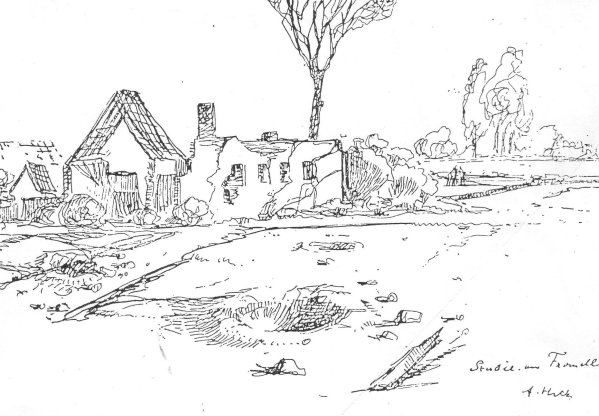
1915 World War I: List Regiment: Gefreiter Adolf Hitler's 16 Reserve Infantry Regiment continue to occupy a position at Fromelles—pictured above in a drawing by Hitler—on a level field with water channels, willow trees and willow stalks; in the distance towards the enemy lines lies an insignificant wood with barbed wire entanglements. Under the direction of their defense-minded commander, Lieutenant General Gustav Scanzoni von Lichtenfels, the regiment works ceaselessly day and night to further fortify their position at Fromelles while fighting off repeated assaults by the enemy. [For further details, Click here.]
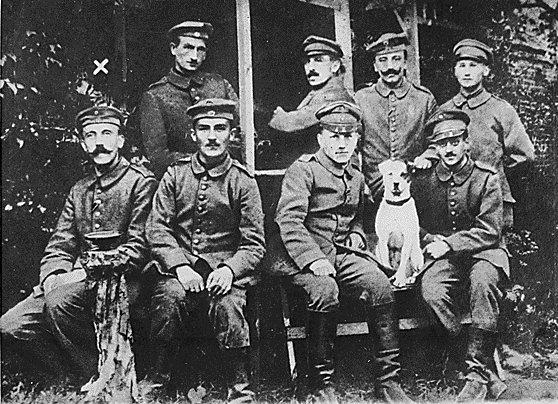
1916 World War I: List Regiment: Gefreiter Adolf Hitler endures trench warfare in Flanders (Artois) with 3 Company, 16 Reserve Infantry Regiment [List Regiment]. [For further details, Click here.]
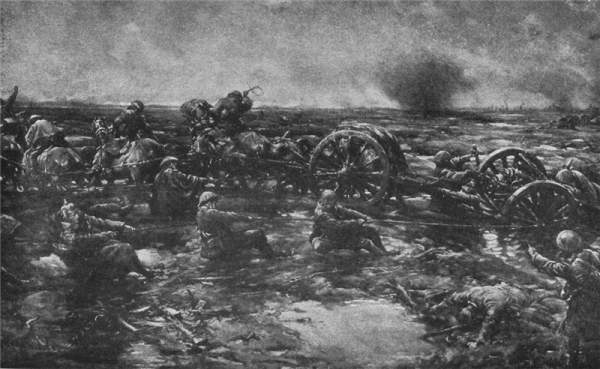
1917 World War I: List Regiment (July 22-September 8): Dispatch Runner Gefreiter Adolf Hitler serves at the front with 3 Company, 16 Bavarian Reserve Infantry Regiment during Phase 2 operations in Flanders. Most of their time in the trenches gas masks are worn, while English bombers attack from the air, and tanks attempt to advance over a long front through seas of mud. [For further details, Click here.]
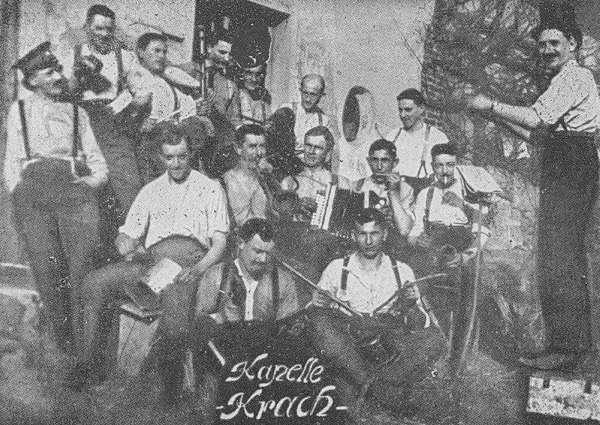
1918 World War I: Various: (August 21-September 27):
Colonel Frantzis, Greek Military Attaché in London, on the Vardar Offensive:
The Italian, Greek, and French troops operating on the left wing of the Allied Armies continued the pursuit of the retreating enemy rearguards towards Kichevo, and advanced to the north of Ochrida and to the west of the lake of the same name, where they reached the Elbassan road. In the centre French cavalry entered Uskub, while the Serbian armies, supported by French and Greek forces, continued their advance on Kumanovo, Egripalanka, and Djumaia. Farther to the east some British and Greek divisions advanced in the direction of Pechevo and Petrie. Our troops are winning new successes.
1921 US Peace Treaty with Hungary:
Considering that the United States, acting in conjunction with its co-belligerents, entered into an Armistice with Austria-Hungary on November 3, 1918, in order that a Treaty of Peace might be concluded: Considering that the former Austro-Hungarian Monarchy ceased to exist and was replaced in Hungary by a national Hungarian Government; Considering that the Treaty of Trianon to which Hungary is a party was signed on June 4, 1920, and came into force according to the terms of its Article 364, but has not been ratified by the United States; Considering that the Congress of the United States passed a Joint Resolution, approved by the President July 2, 1921, which reads in part as follows: "Resolved by the Senate and House of Representatives of the United States of America in Congress assembled: "That the state of war declared to exist between the Imperial and Royal Austro-Hungarian Government and the United States of America by the joint resolution of Congress approved December 7, 1917, is hereby declared at an end.
1922 Cardinal Michael Faulhaber tells a large gathering of Catholics in Munich that the revolution of November 9, 1918 was a case of "perjury and high treason.
A strong supporter of Germany's involvement in the First World War, Faulhaber was appointed Archbishop of Munich-Freising in 1917. Four years later he was made a Cardinal.
After Adolf Hitler obtained power in 1933 Faulhaber tried to maintain good relations with the government while seeking to preserve the power of the Catholic Church. In 1934 he published Judentum, Christentum, Germanentum, a book that defended the principles of racial tolerance and humanity and called for the people of Germany to respect the Jewish religion. However, Faulhaber, and other Catholic bishops, made no open protest against the atrocities being committed against the Jews in Germany.
1929 The German airship Graf Zeppelin ends a round-the-world flight:
Count Zeppelin died March 8, 1917, before the end of World War I. He therefore did not witness either the provisional shutdown of the Zeppelin project due to the Treaty of Versailles or the second resurgence of the zeppelins under his successor, Hugo Eckener.
After the war they were widely used in commercial flights. However, safety problems that led to accidents, including the crash of the Hindenburg in 1937, brought on the end of the zeppelin's popularity.
1932 Schacht to Hitler:
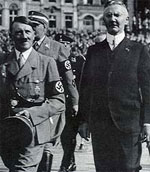
But what you could perhaps do with in these days is a kind word. Your movement is carried internally by so strong a truth and necessity that victory in one form or another cannot elude you for long . . . . Wherever my work may take me in the near future, even if you should see me one day behind stone walls, you can always count on me as your reliable assistant.
1933 Zionism: Chaim Weizmann declines the presidency of the World Zionist Organization but agrees to chair the campaign fund for the settlement of German Jews in Palestine.
1937 From a speech by Von Neurath:

The unity of the racial and national will created through Nazism with unprecedented elan has made possible a foreign policy by which the fetters of the Versailles Treaty were forced, the freedom to arm regained, and the sovereignty of the whole nation reestablished. We have really again become master in our own house and we have created the means of power to remain henceforth that way for all times . . . . The world should have seen from . . . Hitler's deeds and words that his aims are not aggressive.
1939 Various:
Trade Agreement: German Foreign Office Memorandum:
The German-Soviet Trade Agreement . . . which has come into being after extraordinary difficulties, will undoubtedly give a decided impetus to German-Russian trade. We must try to build anew on this foundation and, above all, try to settle a number of questions which could not heretofore be settled, because of the low ebb which had been reached in our trade relations. The framework now set up represents a minimum. Since the political climate is favorable, it may well be expected that it will be exceeded considerably in both directions...Apart from the economic import of the treaty, its significance lies in the fact that the negotiations also served to renew political contacts with Russia and that the credit agreement was considered by both sides as the first decisive step in the reshaping of political relations.
Mediation: Unofficial peace envoy Birger Dahlerus continues his shuttle diplomacy:
Dahlerus: I was in my hotel, late in the evening, about 10:30. Forbes called me up and said he had to see me at once. He came to my hotel and said that Henderson and Hitler had had a meeting on Tuesday evening which had taken a very unsatisfactory course. They had parted after a big quarrel. He asked me what I could suggest under these circumstances. During our conversation I was called on the phone by Goering, and he asked me to come to his house immediately. He told me the same story and seemed very upset at the development. He showed me the German reply to the British note and went through it point by point. He tried to explain to me the reasons for the contents of this note. Finally he told me I should go back to London again immediately and make every effort to explain this unfortunate incident to the British Government. He concluded then by saying that Hitler was busy, and that he was working out a proposal for Poland which should probably be ready the next day.
Britain: Chamberlain makes a firm uncompromising speech in the House of Commons, saying "The catastrophe is not yet upon us, but I cannot say that the danger of it has in any way receded." He warns the press to exercise restraint, and apologizes for not being able to give more than an outline of his communications with Hitler.
The British people are said sometimes to be slow to make up their minds, but, having made them up, they do not readily let go. The issue of peace or war is still undecided, and we still will hope, and still will work, for peace; but we will abate no jot of our resolution to hold fast to the line which we have laid down for ourselves.
Hitler meets with Henderson. Henderson telegrams Viscount Halifax:
In reply to two British proposals, namely, for direct German-Polish negotiations and international guarantee of any settlement, German Government declares:- (1) That, in spite of its scepticism as to the prospect of their success, it accepts direct negotiation solely out of desire to ensure lasting friendship with Britain, and (2) In the case of any modifications of territory German Government cannot undertake or participate in any guarantees without consulting the USSR. 3. Note observes that German proposals have never had for their object any diminution of Polish vital interests, and declares that German Government accepts mediation of Great Britain with a view to visit to Berlin of some Polish plenipotentiary. German Government, note adds, counts on arrival of such plenipotentiary tomorrow, Wednesday, 30th August. 4. I remarked that this phrase sounded like an ultimatum, but after some heated remarks both Herr Hitler and Herr von Ribbentrop assured me that it was only intended to stress urgency of the moment when the two fully mobilized armies were standing face tosface.
Hitler hands his reply to the British note of August 28 to Ambassador Henderson at 7:15 PM:
While the British Government may still believe that these grave differences can be resolved by way of direct negotiations, the German Government unfortunately can no longer share this view as a matter of course. For they have made the attempt to embark on such peaceful negotiations, but, instead of receiving any support from the Polish Government, they were rebuffed by the sudden introduction of measures of a military character.
Palestine: Chaim Weizmann announces that Palestinian Jews will fight in World War II for the Allied cause.
Switzerland orders full mobilization of its frontier forces.
Slovakia: German troops enter Slovakia on Poland's southern frontier, but Ambassadors Kennard and Nokl persuade Beck to postpone any further Polish mobilization.
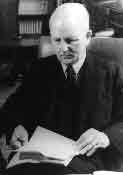
Concordat: Ernst von Weizsaecker, State Secretary in the Foreign Ministry learns of a secret annex to the 1933 Concordat with the Vatican. It stipulates that in the event Germany introduces universal military training, students studying for the priesthood are declared exempt except in the case of general mobilization. In that event most of the diocesan clergy are to be exempt from reporting for service, while all others are to be inducted for pastoral work with the troops or into the medical corps. (THP)
1941 World War II: Various:
Fighting in Iran comes to an end:
At the outbreak of World War II, Iran declared its neutrality, but the country was soon invaded by both Britain and the Soviet Union. Britain had been annoyed when Iran refused Allied demands that it expel all German nationals from the country. When Hitler invaded the Soviet Union in 1941, the Allies urgently needed to transport war materiel across Iran to the Soviet Union, an operation that would have violated Iranian neutrality. As a result, Britain and the Soviet Union simultaneously invaded Iran on August 26, 1941, the Soviets from the northwest and the British across the Iraqi frontier from the west and at the head of the Persian Gulf in the south. Resistance quickly collapsed. Reza Shah knew the Allies would not permit him to remain in power, so he abdicated on September 16 in favor of his son, who ascended the throne as Mohammad Reza Shah Pahlavi. Reza Shah and several members of his family were taken by the British first to Mauritius and then to Johannesburg, South Africa, where Reza Shah died in July 1944.
Serbia: General Milan Nedic is appointed to lead the puppet government backed by Germany:
On 29 August, the German authorities installed General Nedic and his government in power. Nedic would serve as Prime Minister, while the former Yugoslavian Regent, Prince Paul, would be recognized as its head of state. The Germans were short of police and military forces in Serbia, as a result the Germans came to rely on armed Serbian formations to maintain order By October, 1941, Serbian forces under German supervision became increasingly effective against the resistance. These Serbian formations were German armed and equipped.
1942 World War II: Various:
Red Cross announces Japan refuses passage of supplies for U.S. POWs:
On this day in 1942, the international humanitarian agency, the Red Cross, reveals that Japan has refused free passage of ships carrying food, medicine, and other necessities for American POWs held by Japan.
In January 1941, the U.S. government requested that the American Red Cross begin a blood-donor program to provide ready and ample supplies of blood plasma and serum albumin for transfusions for wounded soldiers. More than 13 million donations (each about a pint) were collected.
Among other grassroots efforts organized by local Red Cross chapters were bandage-making "assembly lines," working out of local churches, synagogues, and town halls. Abroad, volunteers worked in military hospitals, reading and writing letters for the wounded. Tens of millions of food packages were prepared and funneled to Allied POWs through Geneva, which served as a clearinghouse. But getting such packages to prisoners in Japan proved particularly difficult. Japan refused to allow even "neutral" ships to enter Japanese waters, even those on humanitarian errands. Despite protests by the Red Cross, Japan allowed just one-tenth of what POWs elsewhere received to reach prisoners in their territories.
As the war came to a close, the Red Cross followed on the heels of liberating military forces to supply relief and aid to those suffering from the ravages of battle. Approximately 20,000 professional Red Cross workers served during the war, along with countless other volunteers. (History.com)
Holocaust: Serbia: Berlin is officially informed that the Jewish problem in Serbia is "totally solved." Of Serbia's 23,000 Jews, 20,000 have been murdered. (THP)
1943 World War II: Denmark abandons its policy of coexisting with the occupying Germans and begins an uprising. German-occupied Denmark scuttles most of its navy; Germany dissolves Danish government.
1944 World War II: Various:
France: During the continuing celebration of the liberation of France from the Nazis, 15,000 American troops march down the Champs Elysees in Paris. "Due to the extensive barricading of streets in the city, the parade served the dual purpose of moving the 28th Division through Paris, and toward combat positions east of the city. For the first time in US military history, soldiers marched straight from a parade, into combat within 24 hours."
Slovak National Uprising takes place as 60,000 Slovak troops turn against the Nazis. The uprising was an attempt to oust the government of pro-Nazi Jozef Tiso. Although the rebel forces were defeated by Germany, guerilla warfare continued until the liberation of Slovakia by the Soviet Army in 1945.
The Warsaw Uprising: British and Americans issue decree that the Polish Home Army (AK) is a "responsible belligerent force" when they learn that members are being arrested or killed by the Soviets.

Holocaust: The Soviets and the Polish Communists jointly announce they have discovered that the Germans have killed 1.5 million people in the concentration camp at Majdanek (Maidanek). This is the first in a series of such announcements. (THP)
1945 Various:
US forces land in Japan following the Japanese surrender: Troops are landed in transport planes at Atsugi airfield, southwest of Tokyo, beginning the occupation. US General Douglas MacArthur heads for Japan to officially accept the surrender of the Japanese.
Even though there was no armed resistance after Japan's surrender, the U.S. presence in Japan was massive: including troops, civilian personnel, teachers, lawyers, engineers, and missionaries; and lasted for about two decades.
The Americans still maintain troops in Okinawa. And while they are ostensibly part of the Asia Pacific security theatre, it is also a means for the United States to "keep the cork in the bottle" of potential renewed Japanese militarism, as one U.S. general put it.
Truman orders Navy to seize control of petroleum refineries:
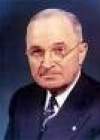
On this day in 1945, President Harry Truman issues Executive Order No. 9639, giving the Secretary of the Navy the power to seize control of and operate a list of petroleum refineries and transportation companies in order to counteract strikes by oil workers. The list of plants seized by the Navy included those owned by industry giants: the Gulf, Shell, Standard and Union oil companies.
Although the Second World War was for all intents and purposes over with the bombing of Hiroshima and Nagasaki on August 6 and 8 respectively, the war did not formally end until the Japanese signed an unconditional surrender agreement on September 2, 1945. Knowing that vast amounts of oil would be required to enable demobilization and the return of military equipment and personnel to the U.S., Truman was forced to intervene between oil workers and management to avoid a crippling shutdown of the industry. Oil, gas and chemical workers had worked longer and harder than usual during the war to meet production demands and now wanted to return to a 40-hour work week. They resented the amount of money oil-industry CEOs were making off of their labor while they simultaneously threatened to lower workers' wages after the war.
Truman ordered the formation of an emergency board to negotiate a settlement between the oil workers' union and industry owners. The union rejected the board's recommendations and on August 25 seemed determined to carry out their strike. At that point, Truman felt he had no other option but to bring in the Navy. Shortly thereafter, the oil workers' union accepted the Truman's administration's terms and ended their strike. Truman's tough action, however, alienated many of his labor supporters.
Truman later employed similar tactics to avoid critical shutdowns of industries during the Korean War. In 1948 and 1950, he intervened in railway disputes between union employees and management and, in 1952, he waded into the middle of a conflict in the steel industry. Truman, like his predecessor Franklin Roosevelt, believed that government intervention was critical to maintaining uninterrupted industrial production in a time of war. (History.com)
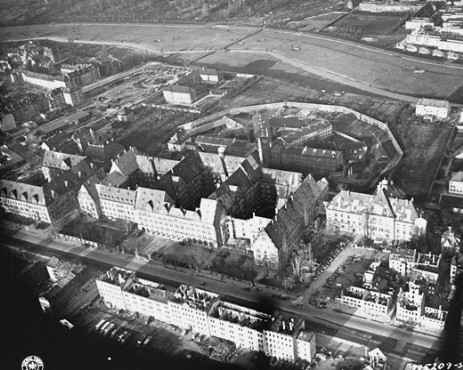
1946 Nuremberg Tribunal: Two Hundred and Fourteenth Day:
Sir David Maxwell Fyfe (British Deputy Chief Prosecutor):With regard to the Jews, when the persecution of the Jews was an openly recognized policy and practice of the Nazi Party, the fact that men voluntarily served their Party in an executive position is in itself sufficient to prove their participation in criminal activity. But we have concrete evidence of the direct participation in the persecution of the Jews by Political Leaders--and again by Political Leaders of all ranks. Within less than a year of the Nazi Government coming to power there is evidence that the Corps of Political Leaders were inciting the people of Germany to persecute the Jews. It is hardly possible to imagine that in a civilized State in the year 1933 instructions should be issued to the Political Leaders under the title "Jew Baiting." Yet that was happening.
[For the full text of today's proceedings, Click here.]1948 Spandau Prison: From Spandau: The Secret Diaries, by Albert Speer:
Book distribution today at a quarter after five. The library, as empty cell, is unlocked. On one side, shelves with our personal books, which we brought with us from Nuremberg. The lions share had been provided by Hess, who in England was able to buy an impressive number of books, even some rare editions, because during his imprisonment he received a captain's pay (in keeping with international agreements, since he had landed in a captain's uniform). Raeder sits down at the table; Hess goes to him and reports: Number Seven. "I am returning: Zinner, Sternglaube und Sternforschung (Astrology and Astronomy)." He mentions his number because Raeder has several times used it when addressing him. Then Hess looks over the book list. Meanwhile Schirach returns Bernauer's 'Theater meines Lebens.' Raeder notes down the choice. Since Hess has not yet made up his mind, Raeder grows impatient. "Have you finished yet?" he asks. Hess decides on a book entitled The School of Danger. When Raeder objects that it is about mountaineering, he replies angrily, "No matter." (Speer II)
1949 Soviets explode atomic bomb:
At a remote test site at Semipalatinsk in Kazakhstan, the USSR successfully detonates its first atomic bomb, code name "First Lightning." In order to measure the effects of the blast, the Soviet scientists constructed buildings, bridges, and other civilian structures in the vicinity of the bomb. They also placed animals in cages nearby so that they could test the effects of nuclear radiation on human-like mammals. The atomic explosion, which at 20 kilotons was roughly equal to "Trinity," the first U.S. atomic explosion, destroyed those structures and incinerated the animals. [For further details, Click here.]
1950 Cold War: State Department official discusses "captive populations": Assistant Secretary of State for Public Affairs Edward W. Barrett declares that most of the "captive populations" in Soviet satellite nations oppose the Russians. Barrett called for an accelerated program of U.S. propaganda designed to capitalize on this weakness in the communist bloc. [For further details, Click here.]
1982 Death: Ingrid Bergman:
On this day in 1982, the Swedish-born actress and three-time Academy Award winner Ingrid Bergman dies of cancer in London on her 67th birthday. Bergman . . . was best known for her role as Ilsa Lund in Casablanca . . . .
Bergman, who was born on August 29, 1915, studied acting at Stockholm's Royal Dramatic Theatre and became a film star in Sweden before making her first Hollywood movie . . . . In 1942, Bergman co-starred in Casablanca with Humphrey Bogart, who uttered the famous line to her: "Here's looking at you, kid." She received a Best Actress Academy Award nomination for 1943's For Whom the Bell Tolls. [For further details, Click here.]
Note: Produced very quickly, and on a shoe-string budget, Casablanca was one of the best-loved films of World War II, despite several illogicalities. For one of the most famous scenes, click on "Play it, Sam."
1991 Soviets Bar Communist Party Activities:
After three hours of anguished debate, the Soviet Parliament voted today to suspend all activities of the Communist Party pending an investigation of its role in the coup. It was an action that confirmed the demise of the old regime even as the search quickened for new forms of association and order.
The fate of the party was already sealed before Parliament's vote. Individual republics had closed its offices and seized its vast properties and funds and President Mikhail S. Gorbachev had quit as its General Secretary and had called on the leadership to step down.
But Parliament was the only national institution with the formal powers to act against the entire organization, and its decision served to confirm the indictment already passed by the people. [For further details, click here]
Edited by Levi Bookin (Copy editor) Click to join 3rdReichStudies Disclaimer: This site includes diverse and controversial materials--such as excerpts from the writings of racists and anti-Semites--so that its readers can learn the nature and extent of hate and anti-Semitic discourse. It is our sincere belief that only the informed citizen can prevail over the ignorance of Racialist "thought." Far from approving these writings, this site condemns racism in all of its forms and manifestations.
levi.bookin@gmail.com







Fair Use Notice: This site may contain copyrighted material the use of which has not always been specifically authorized by the copyright owner. We are making such material available in our efforts to advance understanding of historical, political, human rights, economic, democracy, scientific, environmental, and social justice issues, etc. We believe this constitutes a "fair use" of any such copyrighted material as provided for in section 107 of the US Copyright Law. In accordance with Title 17 U.S.C. Section 107, the material on this site is distributed without profit to those who have expressed a prior interest in receiving the included information for research and educational purposes. If you wish to use copyrighted material from this site for purposes of your own that go beyond 'fair use', you must obtain permission from the copyright owner.
Please Note: The list-owner and moderators of 3rdReichStudies are not responsible for, and do not necessarily approve of, the random ads placed on our pages by our web server. They are, unfortunately, the price one pays for a 'free' website.



