
May 10
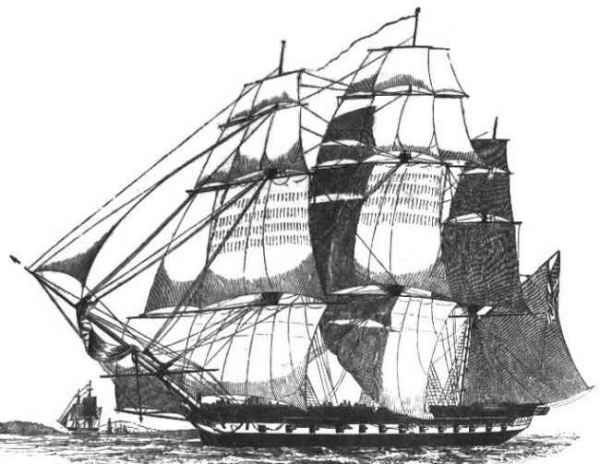
1796 The USS United States, the first of the nation's new warships, is launched in Philadelphia:
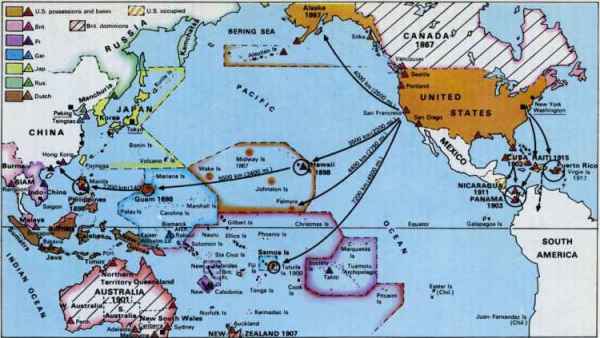
From The History of the World by J. M. Roberts:The American aspiration to non-involvement with the outside world was already clear in 1793, when the troubles of the French revolutionary war led to a Neutrality Proclamation rendering American citizens liable to prosecution in American courts if they took any part in the Anglo-French war. The bias of American policy already expressed in this received its classical formulation in 1796. In the course of Washington's Farewell Address to his "Friends and Fellow-Citizens" as his second term drew to a close, he chose to comment on the objectives and methods which a successful foreign policy should embody, in language to be deeply influential both on later American statesman and on the national psychology. In retrospect, what is now especially striking about Washington's thoughts is their predominantly negative and passive tone . . . .
Washington warned his countrymen against assumptions of permanent or special hostility or friendship with any other nation. In all this there was no hint of America's future destiny as a world power (Washington did not even consider other than European relations; America's future Pacific and Asian role was inconceivable in 1796).
1857 Indian Mutiny:
Expansion of British East India Company control in India in the first half of the century leads many Indians to fear subjugation of social and religious customs, causing growing resentment to the British presence. In the Bengal Army, with more competent officers taking administrative positions, morale declines. In 1857 the British introduce the new Enfield Rifle, and its cartridge, greased with beef or pig fat (or both), [or neither, in fact—Ed.] must be bitten open before loading: a requirement seen by the Hindu and Muslim troops as a religious defilement. Some troops refuse its use and at their punishment the garrison revolts, killing all Britons.
The mutiny spreads to Delhi with Europeans soon being killed mercilessly throughout Bengal. All British troops are hastily assembled assisted by still loyal Punjab and Bombay troops. Delhi is recaptured, a mutineer siege of the British residents of Lucknow is lifted and finally the Rani of Jhansi, the most capable leader in the mutiny, is defeated in Central India.
The mutiny over, avenged with as much ruthlessness as it began, the British government seizes administration of India from the East India Company and reorganizes the Army to increase the ratio of British to Indian troops. [For further details, Click here]
1871 Franco-Prussian War: Treaty of Frankfurt am Main:
The humiliating defeat of Louis Napoleon's Second Empire of France is made complete . . . when the Treaty of Frankfurt am Main is signed, ending the Franco-Prussian War, and marking the decisive entry of a newly unified German state on the stage of European power politics, so long dominated by the great empires of England and France.
At the root of the Franco-Prussian conflict was the desire of the ambitious statesman Prince Otto von Bismarck to unify the collection of German states under the control of the most powerful of them, his own Prussia. The event that immediately precipitated the war was the Bismarck-engineered bid by Prince Leopold, of the Prussian Hohenzollern royal family, for the throne of Spain, left empty after a revolution in 1868. Horrified by the idea of a Prussian-Spanish alliance, the French government of Louis Napoleon (or Napoleon III) blocked this idea and, determined to humiliate Prussia into subordination, insisted that the Prussian king, Wilhelm I, personally apologize to the French sovereign and promise that there be no further such attempts by the Hohenzollerns. Wilhelm refused, and subsequently authorized Bismarck to publish the French demands and his own rejection of them; the prince did so knowing such a move would precipitate a war, which he himself greatly desired in order to free Prussia completely from French influence.
Eager to regain prestige after numerous defeats abroad and reassert its military dominance on the European continent, France declared war on July 19, 1870. Unfortunately for the French, the states of southern Germany honored their treaties with mighty Prussia and immediately backed Wilhelm's armies. Thus the Germans were able to marshal some 400,000 men, double the number of French troops, at the outset of the war. Under the supreme command of Wilhelm and guided by Count Helmuth von Moltke—known as Moltke the Elder, to distinguish him from his nephew, who would command German forces during World War I—three German armies cut a broad swath through France, gaining the upper hand almost from the beginning of the fighting.
The crucial battle of the war, fought around the town of Sedan in northern France, resulted in a crushing German victory, in which Napoleon III himself was captured. Upon learning of the emperor's capture, Paris exploded into rebellion; the legislative assembly was dissolved, and France was declared a republic. Meanwhile, the Germans were closing in: by the end of September, they had captured Strasbourg and completely surrounded France's capital city, which they subjected to merciless siege and bombardment for the next several months. On January 19, 1871, the French government was forced to open negotiations for surrender. A day earlier, in an added humiliation for France, the Bismarckian dream of unification was fulfilled, as Wilhelm I of Prussia was crowned emperor, or Kaiser, of the new German state, in a ceremony that took place in the sumptuous Hall of Mirrors, at Paris's Versailles palace.
By the terms of the final treaty, signed on May 10, 1871, at Frankfurt am Main, Germany annexed the French provinces of Alsace (excluding Belfort) and Lorraine; the French were also ordered to pay an indemnity of five billion francs. German troops occupied France until September 1873, when the amount had been paid in full. The Franco-Prussian War and the nearly three years of German occupation that followed marked the beginning of a growing enmity between anxious France, its influence and power in decline, and striving Germany, a technologically and industrially superior nation that by the first decade of the 20th century had built the most powerful land army on the European continent. In the summer of 1914, this rivalry would explode into full-scale global warfare, pitting France and the Allies against Germany and the Central Powers in the most devastating conflict the world had yet seen.
1877 Communications: First phone in the White House:
President Rutherford B. Hayes has the White House's first telephone installed in the mansion s telegraph room. President Hayes embraced the new technology, though he rarely received phone calls. In fact, the Treasury Department possessed the only other direct phone line to the White House at that time. The White House phone number was " 1." Phone service throughout the country was in its infancy in 1877. It was not until a year later that the first telephone exchange was set up in Connecticut and it would be 50 more years until President Herbert Hoover had the first telephone line installed at the president's desk in the Oval Office. [For further details, Click here]
1878 Birth: Gustav Stresemann: German Chancellor 1923, Nobel Peace Prize 1926: [Stresemann] passionately supported Germanic policy both before and during World War I. He believed in force, in authority, in discipline. He argued as early as 1907 for the creation of a strong navy, seeing in it the instrument by which to extend and protect German overseas trade; in 1916, he supported unrestricted submarine warfare; he helped to defeat the government of Bethmann-Hollweg, which he thought too temperate; he opposed the Treaty of Versailles. Dismayed, however, to discover Germany's true military position in the fall of 1918, Stresemann found his ideas of the world changing. Disillusioned with an imperial government that believed in force yet did not possess adequate force, and indeed realizing that the policy of force and conquest in itself is ultimately ruinous, he began to see the world as a jigsaw of political and commercial interrelationships, each nation an individual piece in the puzzle and each fitting into another.
A month after the armistice of November 11, 1918, Stresemann formed the German People's Party, was elected to the national assembly which gathered at Weimar in 1919 to frame a new constitution, was elected to the new Reichstag in 1920 and spent the next three years in opposition. From August 13 to November 23, 1923, Stresemann was chancellor of a coalition government. In his short-lived ministry he dealt firmly with insurrection in Saxony, restored order in Bavaria after Hitler's Putsch failed, ended the passive resistance of Germans in the Ruhr to the French occupying forces, and began the work of stabilizing Germany's currency. In 1924 Stresemann's successor chose him as his secretary of foreign affairs, an office he was to fill with such distinction under four governments that he was called the greatest master of German foreign policy since Bismarck. [But he had to give way to Rosenberg for that title.—Ed. :=)]
1886 Birth: Karl Barth: One of the foremost Protestant thinkers of the twentieth century and a vigorous opponent of National Socialism who will strongly oppose the "German Christians" who will support Hitler. In 1935, Barth, born in Switzerland, will be removed from his position at the University of Bonn, for refusing to declare an oath of loyalty to Hitler, and will return to the University of Basel, where he will publish his most famous work, Kirchliche Dogmatik, one of the central works of modern Protestantism.
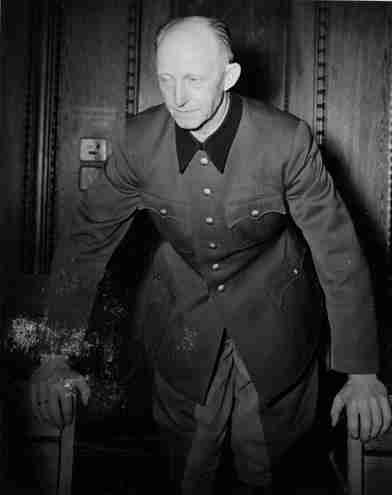
1890 Birth: Alfred Jodl: Colonel-General, and Chief of staff of the German armed forces supreme command (OKW) from August 23 1939. In 1935, Jodl was promoted to the rank of general major. After the Anschluss he was sent to Vienna as head of the 44th Artillery Command. He returned to Germany and in September he took part in the invasion of Poland. A strong supporter of the National Socialist German Workers Party (NSDAP), Jodl worked closely with Adolf Hitler and in October, 1939, was appointed chief of operations. In January, 1944, Jodl was promoted to the rank of Generaloberst. Jodl came close to be killed when the bomb exploded in the July Plot. He recovered and in May, 1945, signed the unconditional surrender of Germany to the Allies. Soon afterwards he was arrested and charged with war crimes. At the Nuremberg War Crimes Trial Jodl was charged of approving orders that violated the rules of war. Alfred Jodl was found guilty and hanged on 16th October, 1946. I was born in 1890 on 10 May. A great-grandfather of mine was an officer; my father was an officer; an uncle was an officer; my brother became an officer; my father-in-law was an officer—I can well say that the military profession was in my blood. As an officer, all party politics were entirely remote to me, and especially the offshoots of the post-war period. If I look at the background from which I come, the attitude of my parents, I must say that I would have been closest to the National Liberal Party and its ideas. In any event, my parents never voted anything but National Liberal. 1897 Birth: Einar Gerhardsen: Prime minister of Norway:
During World War II, Gerhardsen took part in the organized resistance against Nazi occupation and was interned in concentration camps at Grini in Norway and at Sachsenhausen in Germany. After the war, it fell upon Gerhardsen to form the interim government. During and after he held office he was a greatly respected figure in the eyes of the people, even amongst those not sharing his social democratic views. Often referred to as "Landsfaderen" (Father of the Nation), he is generally considered as one of the architects of the rebuilding of Norway.
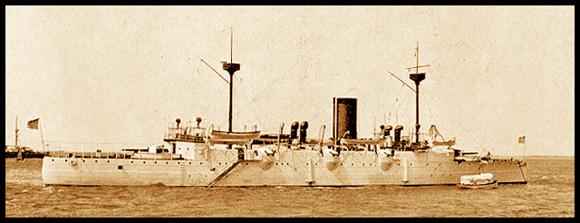
1898 Spanish-American War: US Navy warships are sighted off the coast of Puerto Rico. (Trask) 1903 Birth: Otto Bradfisch: Economist, jurist, SS Obersturmbannfuehrer, Leader of Einsatzkommando 8 of Einsatzgruppe B of the Security Police (Sicherheitspolizei) and the SD, and Commander of the Security Police in Litzmannstadt (Lodz) and Potsdam.
Until 1953, Bradfisch managed to hide his true identity by using the name Karl Evers. He busied himself first in farming and then later in mining. When he became an insurance agent in Kaiserslautern, eventually for Hamburg-Mannheimer as a regional director, he once again began using his true name. On 21 April 1958, Bradfisch was temporarily seized and sentenced by the Munich State Court I on 21 July 1961 to 10 years in labor prison (Zuchthaus) for the crime, committed with Bradfisch as part of a group, of abetting collaborative murder in 15,000 cases. In 1963, he was sentenced to 13 years in prison.
1913 Countdown to Infamy: Former President Theodore Roosevelt writes to Assistant Secretary of the US Navy, Franklin Roosevelt: It is not my place to advise, but there is one matter so vital I want to call your attention to it. I do not anticipate trouble with Japan, but it may come and if it does it will come suddenly. In that case we shall be in an unpardonable position if we permit ourselves to be caught with our fleet separated. There ought not to be a battleship or any formidable fighting craft in the Pacific unless our entire fleet is in the Pacific. Russia�s fate ought to be a warning for all time as to the criminal folly of dividing the fleet if there is even the remotest chance of war. (Lash) 1915 World War I: Various:
Lusitania: Count von Bernstorff offers his condolences for the tragic loss of life upon the sinking of the liner, but this only serves to rub salt into the British wounds. President Woodrow Wilson sympathized with the British, despite his advice to Americans to remain neutral "In fact as well as in name during these days that are to try men's souls."
Zeppelins: The first raids on Britain take place. List Regiment: Gefreiter Adolf Hitler's 16th RIR reports 309 dead from two days fighting. From the Regiment's official history: It was no secret to French GQG that great masses of German troops were demanded in the East and that because of this the strong superiority of the Franco-English armies facing the Germans on the Westen Front was guaranteed. The prospects of success had never been so favorable. At La Bass�e, the English and Indians [were] given bloody heads by the brave Westphalians. Before Fromelles they fared no better, here Bavarians held sway. [For further details, Click here.] 1916 World War I: Various: List Regiment: Gefreiter Adolf Hitler endures trench warfare in Flanders (Artois) with 3 Company, 16 Reserve Infantry Regiment. [For further details, Click here.] War at Sea: Germany announces abandonment of its extended submarine campaign. During this period Great Britain, seeking to maintain a blockade, illegally seizes American vessels with such frequency, that Wilson threatens to provide convoys for all American merchant ships, to guarantee their neutrality rights.
1917 World War I: Various:
War at Sea: Allied merchant ships get destroyer escorts to fend off German attacks in the Atlantic, as the Allied convoy system is officially adopted.
List Regiment: Gefreiter Adolf Hitler's 16 Reserve Infantry Regiment, 3 Company, participate in the Arras action, being redeployed east of Vimy Ridge. [For further details, Click here.] Alexander Guchkov on Military and Civil Unrest in Russia: Unfortunately, the first feeling of radiant joy evoked by the revolution has given place to one of pain and anxiety. The Provisional Government explained the cause of this in its recent declaration, in which it was pointed out that the destruction of the old forms of public life, to which an end had been put by the revolution, had been effected more rapidly than had the creation of new forms to replace them. It is especially regrettable that the destruction has touched the political and social organization of the country before any life centre has had time to establish itself and to carry out the great creative work of regeneration. How will the State emerge from this crisis.
1918 World War I: List Regiment: Gefreiter Adolf Hitler's 16th RIR is sent back to hold a sector near an earlier position at Laon. [For further details, Click here.] 1919 Death: Mehmed Kemal: For the Armenian Genocide: On this date, an official in Istanbul was hanged for his role in the mass slaughter of the Armenian minority in the Ottoman Empire. A few secondary sources say April 12 rather than April 10, but the earlier date is apparently more accurate. Kemal Bey's hanging in Bayezid Square occurred in the immediate aftermath of the Great War. The moribund Sultanate splintered apart in the war instituted tribunals for wartime offenses by the Young Turks, who had run the government during the war . . . . 1920 Rudolf Hess, a decorated combat veteran who is a member of the Thule Society, as well as Ernst R�hm's Iron Fist, attends a Monday night meeting of the NSDAP, in the Sprechabend at the Sterneckerbrau. Hitler, the featured speaker, gives forth on the topic "The Worker and The Jews." Hess, who had been shot in the leg on May 1, 1919 while a member of a Freikorps unit battling for control of Munich, is hypnotized by Hitler's oratory. 1921 In an interview for the Pan-German paper Deutsche Zeitung, an unusually coy Hitler characterizes his role, not as the fellow who would "save the Fatherland that was sinking into chaos," but as "the agitator who understood how to rally (sammeln) the masses." He goes on to imply that he sees himself as a sort of John the Baptist, a mere forerunner of the dictator to come: "The architect who clearly pictured in his own eyes the plan and design of the new building, and with calm sureness and creativity was able to lay one stone on the other. He needed the greater one behind him, on whose command he could lean." [For further details, Click here.] 1922 Hitler speaks before a large crowd at the Burgerbrau on the subject "The Unknown Soldier."
We do not want to awaken peace and insight and harmony, but rather hate! Hate for the criminals who rendered meaningless the death of our heroes, and who are still our "leaders" today. We also want to incite hate for those who deserve no mercy, those who are still selling out and betraying us, who still want to lead us to the slaughter; not to liberation, but to bled-to-death ruin. We want to forge a sword of revenge . . . . 1924 J. Edgar Hoover is named acting director of the Bureau of Investigation (now the FBI): By the end of the year he was officially promoted to director. This began his 48-year tenure in power, during which time he personally shaped American criminal justice in the 20th century
Hoover first became involved in law enforcement as a special assistant to the attorney general, overseeing the mass roundups and deportations of suspected communists during the Red Scare abuses of the late 1910s. After taking over the FBI in 1924, Hoover began secretly monitoring any activities that did not conform to his American ideal. [For further details, Click here. Note: this article, like many others, is not entirely objective. Hoover mainly campaigned against crime, and also started tracking Nazi intelligence agents, and saboteurs before World War II.—Ed.]
1933 Various:
Nazi Germany: The property of the Social Democratic Party is confiscated on Hitler's order. (THP)
USA: Anti-Nazi parade through lower Manhattan is staged by the American Jewish Congress.
France: A large anti-Nazi rally is held at the Trocadero in Paris.
German Chancellor Hitler speaks in Berlin: It is not enough to say that the German economic distress is a phenomenon resulting from a world crisis, from a general economic distress, since, of course, exactly in the same way every other people could plead the same excuse, could adduce the same reason. It is clear that even so this distress cannot have its roots all over the world, those roots must always be found within the life of peoples. And though only one thing is probably true—that these roots are perhaps the same in the case of many peoples—yet one cannot hope to master this distress by the mere statement that the presence of a certain distress is a feature of the age; rather it is clearly a necessity to disclose these roots in the internal life of a single people and to cure the distress there where one can really effect a cure. [For further details, Click here.]
1936 Italy: The League of Nations votes to leave its sanctions against Italy in place.
1940 World War II: Various:
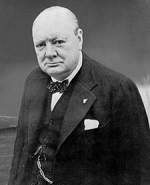
Winston Churchill—First Lord of the Admiralty—is called to replace Neville Chamberlain as British prime minister, following the latter's resignation after losing a vote of confidence in the House of Commons. In 1938, Prime Minister Chamberlain signed the Munich Pact with Nazi leader Adolf Hitler, giving Czechoslovakia over to German conquest but bringing, as Chamberlain promised, "peace in our time." In September 1939, that peace was shattered by Hitler's invasion of Poland. Chamberlain declared war against Germany but during the next eight months showed himself to be ill-equipped for the daunting task of saving Europe from Nazi conquest. After British forces failed to prevent the German occupation of Norway in April 1940, Chamberlain lost the support of many members of his Conservative Party. On May 10, Hitler invaded Holland, Belgium, and the Netherlands. The same day, Chamberlain formally lost the confidence of the House of Commons. Churchill, who was known for his military leadership ability, was appointed British prime minister in his place . . . . In the first year of his administration, Britain stood alone against Nazi Germany, but Churchill promised his country and the world that the British people would "never surrender." They never did. [But sober analysis shows that, had Hitler called Churchill's bluff, Britain would have been defeated; the war in Europe and the Far East would have been lost, while America stood by and watched.—Ed.]
Germany invades France and the Low Countries of Belgium, Holland, and Luxembourg:
Counting the ten divisions of the British Expeditionary Force (BEF), the Belgian army, and the French army, the Germans are outnumbered and outgunned. Both the Dutch and Belgians fight back after receiving the brunt of the opening offensives. The Dutch mine bridges, block roads, and flood wide areas. Luxembourg, with no defensive forces, is occupied with only scattered civilian resistance. The German code word for the general attack is "Danzig." (THP) Every means was tried to incite [General Wilhelm] Keitel to warn Hitler before the invasion of Belgium and Holland, and to tell him—that is, Hitler—that the information which had been submitted by Keitel regarding the alleged violation of neutrality by the Dutch and Belgians was wrong. Counterintelligence [Canaris] was to produce these reports that would incriminate the Dutch and Belgians. Admiral Canaris, at that time, refused to sign these reports . . . . He told Keitel repeatedly that these reports, which were supposedly produced by the OKW, were wrong. That is one instance when Keitel did not transmit to Hitler that which he should have. [See: What Were Adolf Hitler's Major Blunders?] The Invasion of Iceland (Operation Fork): A British military operation conducted by the Royal Navy, the Royal marines and a small Canadian task force.
The invasion began in the early morning,.with British troops disembarking in Reykjavík, capital of neutral Iceland. Meeting no resistance, the troops moved quickly to disable communication networks, secure strategic locations and arrest German citizens. Requisitioning local means of transportation, the troops moved to Hvalfjorur, Kaldaarnes, Sandskeii and Akranes to secure landing areas against the possibility of a German counterattack. In the following days air defence equipment was deployed in Reykjavik and a detachment of troops was sent to Akureyri.
In the evening of 10 May, the government of Iceland issued a protest, charging that the neutrality of Iceland had been "flagrantly violated" and "its independence infringed" and noting that compensation would be expected for all damage done. The British promised compensation, favourable business agreements, non-interference in Icelandic affairs and the withdrawal of all forces at the end of the war. Resigning themselves to the situation the Icelandic authorities provided the invasion force with de facto cooperation, though formally maintaining a policy of neutrality.
The invasion force consisted of 746 marines, ill-equipped and only partially trained.[2] Although it succeeded in its mission, it was manifestly insufficient to defend an island of 103,000 km². On 17 May, 4,000 troops of the British Army arrived to relieve the marines. This force was subsequently augmented, to a final force strength of 25,000. American forces relieved the British a year later, although their country was still officially a non-belligerent. They remained there for the duration of the war. [For further details, Click here]
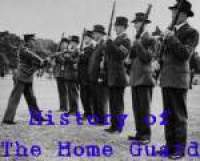
Britain: The Home Guard is formed:
Originally called the Local Defence Volunteers, they are formed as a last-ditch defense against an expected German invasion. [This was Britain's secret weapon: The invaders would have been overcome with laughter.—Ed.]
The Blitz: The first German bombs of the war fall on England at Chilham and Petham, in Kent. [See: Why Did Hitler Lose The Battle of Britain?]
From Hans Frank's diary: Then the Governor General deals with the problem of the compulsory labor service of the Poles. Upon the pressure from the Reich it has now been decreed that compulsion may be exercised in view of the fact that sufficient manpower was not voluntarily available for service inside the German Reich. This compulsion means the possibility of arrest of male and female Poles. Because of these measures a certain disquietude had developed which, according to individual reports, was spreading very much and might produce difficulties everywhere. General Field Marshal Goering some time ago pointed out, in his long speech, the necessity to deport into the Reich a million workers. The supply so far was 160,000. However, great difficulties had to be overcome here. Therefore it would be advisable to cooperate with the district and town chiefs in the execution of the compulsion, so that one could be sure from the start that this action would be reasonably expedient. The arrest of young Poles when leaving church service or the cinema would bring about an ever increasing nervousness of the Poles. Generally speaking, he had no objections at all to the rubbish, capable of work yet often loitering about, being snatched from the streets. The best method for this, however, would be the organization of a raid; and it would be absolutely justifiable to stop a Pole in the street and to question him as to what he was doing, where he was working . . .
1941 World War II: Various:
Rudolf Hess—Hitler's deputy—flies from Augsburg and parachutes into Eaglesham near Glasgow, Scotland, in an apparent attempt to negotiate a peace deal. He is arrested and imprisoned for the rest of the war. Hess will end up serving a life sentence at Spandau prison until his death in 1987. Hess's attempt to negotiate peace and subsequent lifelong imprisonment have given rise to many theories about his motivation for flying to Scotland, and conspiracy theories about why he remained imprisoned alone at Spandau, long after all other convicts had been released. On 27 September and 28 September 2007, numerous British news services published descriptions of conflict between his Western and Soviet captors over his treatment and how the Soviet captors were steadfast in denying repeated entreaties for his release on humanitarian grounds during his lastyears. Hess was sure that Hitler would welcome a novel peace venture but would never allow him to risk his life in the attempt. Hadn't he already refused to let Hess fly at the front? Therefore, secrecy was essential. It was the decision of a naive, not too bright acolyte who, according to Adjutant Wiedemann, was the Fuehrer's "most devoted and dedicated subordinate." A painfully shy man whose greatest ambition was to further his master's career, Hess hid behind tightly stern lips, heavy jowls, fanatic eyes and a fearsome pair of eyebrows. But this was no Teutonic Oliver Cromwell. Once he smiled, the severity vanished. It was this Parsifal who conjured up the dream of flight to the enemy, this man of culture without judgment, this completely devoted servant who convinced himself that he was carrying out the true will of his master . . . . The Blitz: The worst night of the Blitz in London sees more than 1,400 people killed, as Germany drops 100,000 bombs. The House of Commons is destroyed.
1942 World War II: War with Japan: The Thai Phayap Army invades the Shan States during the Burma Campaign.
1943 World War II: From a Wehrmacht report: On 30 March 1943 in Toftefiord an enemy cutter was sighted. Cutter was blown up by enemy. Crew; 2 dead men, 10 prisoners. Cutter was sent from Scalloway (Shetlands) by the Norwegian Navy. Arms: Two Colt machine guns, two mounted machine guns, a small transmitter . . . 1,000 kilograms of explosives . . . . Purpose: Forming an organization for sabotaging strong-points, battery positions, staff and troop billets, and bridges . . . . Fuehrer order executed by the SD. 1945 World War II: Various:
Death: Richard Gluecks: SS-Brigadefuehrer (major-general), charged with participation in the mass murder of Jews in the "Final Solution" . . . . A native of Dusseldorf, he served as an artillery officer during World War I, and then became a merchant. After Hitler came to power, Gluecks became a member of the Nazi Party and the SS. In 1936 he was appointed chief of staff under Theodor Eike, inspector of concentration camps, and succeeded him in 1940. In 1941, when the Inspection Authority was absorbed into the "Economic and Administrative Main Office" (WVHA) of the SS, Gluecks became head of Amtsgruppe D, which supervised the concentration camps (see Concentration *Camps). Gluecks was responsible for the establishment of Auschwitz and the construction of gas chambers. Under his jurisdiction, exploitation of prisoner's labor was introduced in the camps. He died in Flensburg, seemingly by suicide.
Churchill to Field-Marshal Alexander (Italy): I have seen the photograph. The man who murdered Mussolini made a confession, published in the Daily Express, gloating over the treacherous and cowardly method of his action. In particular he said he shot Mussolini's mistress. Was she on the list of war criminals? Had he had any authority from anybody to shoot this woman? It seems to me the cleansing hand of British military power should make inquiries on these points.
World War II: Czechoslovakia: Russian troops occupy Prague.
World War II: Burma: The Allies capture Rangoon from the Japanese.
1946 Nuremberg Tribunal: On day 126, Grand Admiral Karl Doenitz under cross-examination by Sir David Maxwell-Fyfe: Doenitz: And the only cases in 5.5 years of war, during several thousand attacks, are the ones brought up here. 1946 Wunderwaffen: A captured German V-2 rocket achieves high-altitude space flight at White Sands Proving Ground, reaching an altitude of 70 miles. (Braun) 1957 From an NCS (National Security Council) Memorandum: After Mr. Cutler had finished his briefing, and had noted that the costs of the program had increased from the original estimate (May 1955) of $15-20 million to the estimate of April 1957—of $110 million—he turned to call upon Secretary Holaday to present the Defense Department report. The President [Eisenhower], however, interrupted with a vigorous complaint to Mr. Cutler that, before he slid over some very important facts, it would be well to recall that the original program, calling for six satellites, was primarily a safety program, designed to assure that at least one of these six satellites could be successfully orbited. There was no intention necessarily to launch six satellites. Another problem which disturbed the President was the very costly instrumentation currently being provided for the six satellites. Such costly instrumentation had not been envisaged, when NSC 5520 had originally been approved by the President. The President therefore stressed that the element of national prestige, so strongly emphasized in NSC 5520, depended on getting a satellite into its orbit, and not on the instrumentation of the scientific satellite. [For further details, Click here.] 1960 Spandau Prison: From Spandau: The Secret Diaries by Albert Speer: An American reconnaissance plane, a so-called U-2, has been shot down deep inside the Soviet Union [May 1, 1960]. This morning the newspapers report that Khrushchev now considers the Paris summit conference wrecked before it has started. [Baldur von] Schirach is once more in despair. (Speer II) Edited by Levi Bookin (Copy editor) Click to join 3rdReichStudies Disclaimer: This site includes diverse and controversial materials--such as excerpts from the writings of racists and anti-Semites--so that its readers can learn the nature and extent of hate and anti-Semitic discourse. It is our sincere belief that only the informed citizen can prevail over the ignorance of Racialist "thought." Far from approving these writings, this site condemns racism in all of its forms and manifestations. 
Louis Napoleon with Bismarck after the Battle of Sedan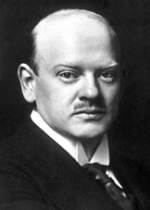

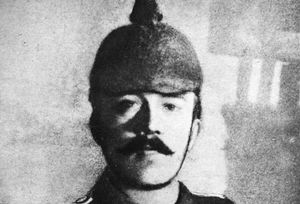
Much testimony at the trial pointed to the governor's fervor for massacres. According to Armenian priest who survived the slaughter, a Turkish officer had told him that Kemal "made a vow on the honor of the Prophet": "I shall not leave a single Armenian alive in the Sanjak of Yozgat."
A response to the New York Times' report of the hanging noted that his part [in the massacre] was that of an executioner, and that the originators of the plan to exterminate the Armenians were primarily Enver, Talaat, and Djemal. These "Three Pashas" who had driven Ottoman policy during the war had fled abroad. They would be condemned to death in absentia, and though none would hang, neither would they outlive Mehmed Kemal by as much as four years. They were among the many unpunished perpetrators of the slaughter hunted down by Armenian assassins. The latter two were avenged by Operation Nemesis; Enver Pasha died in battle in Tajikistan during the Russian Civil War.
Though overshadowed in historical import by those three, our day's principal is distinguished as the first person executed for "crimes against humanity." This novelty, combined with the nature of the trial's 'victor's-justice', was immediately controversial.
Hess's 20-year-old girlfriend and future wife, Ilse Pr�hl, describes Hess when he returned from hearing Hitler: "He was like a new man, lively, radiant, no longer gloomy, not despondent. Something completely new, something stirring must have happened to him."
The Jew has not become poorer. He is gradually puffing up. And if you don't believe that, I ask you to look at our health resorts. There you'll find two types of people: the German who goes there for the first time in a long time to get some fresh air and to recuperate, and the Jew, who goes there to lose his fat. And go into our mountains. Whom do you find there in brand-new, splendid yellow hiking boots, with pretty backpacks in which there is usually nothing useful? And why should there be? The Jews go up there to the hotel, usually as far as the railway goes, and where the train stops, they stop too. Then they just sit around within a kilometer of the hotel, like blowflies around a corpse . . . .
Count Lerchenfeld said in the last session of parliament that his feeling "as a human being and a Christian" would prevent him from being an anti-Semite. I say: my Christian feeling tells me that my lord and savior is a warrior. It calls my attention to the man who, lonely and surrounded by only a few supporters, recognized the Jews for what they were, and called for a battle against them, and who, by God, was not the greatest sufferer, but the greatest warrior . . . .
As a human being, it is my duty to see to it that humanity will not suffer the same catastrophic collapse as did that old civilization two thousand years ago, a civilization which was driven to its ruin by the Jews. . . . I am convinced that I am really a devil and not a Christian, if I do not feel compassion and do not wage war, as Christ did two thousand years ago, against those who are stealing from and exploiting these poverty-stricken people.
Two thousand years ago a man was similarly denounced by this particular race which today denounces and blasphemes all over the place. . . . That man was dragged before a court and they said: he is arousing the people! So he, too, was an agitator! [For further details, Click here.]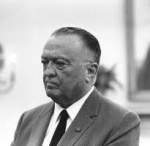
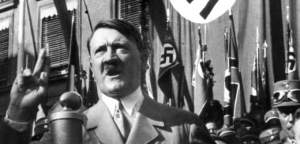
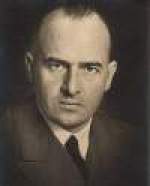

His secretary, Hildegard Fath, noticed that Hess often did not listen to what she was saying. His wife was equally aware of his preoccupation. What surprised her even more was the unusual amount of time he spent with their four-year-old son, who bore Hitler's secret name, Wolf. Surprising too, in view of Hess's reluctance to pose for pictures, was his own recent suggestion that photographs of father and son be taken.
Hess rose early on the morning of May 10, a Saturday, and, upon learning that the weather forecast was good, made arrangements for the flight. Never had he been more gallant to his wife. After tea he kissed her hand and then stood gravely at the door of the nursery "with an air of one deep in thought and almost hesitating." She asked him when he was returning and, told it would be Monday at the latest, she bluntly said, "I cannot believe it. You will not come back as soon as that!" She guessed he was bound for a meeting with someone like Petain but he feared that he had guessed the truth. He turned "hot and cold in turns" and, before she could say anything more, he dashed into the nursery to take a last look at their slumbering son.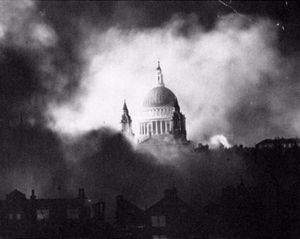
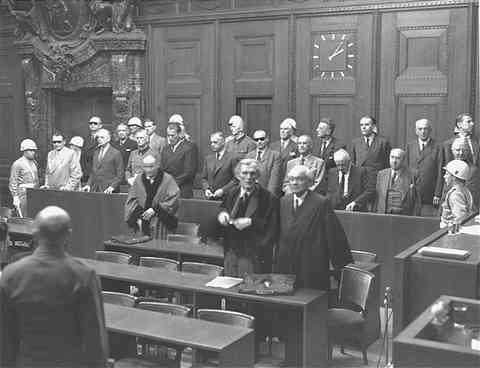
Maxwell-Fyfe: Yes, and of course for the 2.5 of these years that the submarine commanders have been shooting up survivors, you are not likely to get many cases, are you? I just want to ask you one other point . . .
Doenitz: Submarine commanders with the exception of the case of Eck have never shot up shipwrecked persons. There is not a single instance. That is not true.
Maxwell-Fyfe: That is what you say.
Doenitz: In no case is that proved. On the contrary, they made the utmost efforts to rescue. No order to proceed against shipwrecked people has ever been given the U-boat force, with the exception of the case of Eck, and for that there was a definite reason. That is a fact.
Maxwell-Fyfe: Well, now, tell me this: Did you know that the log of the Athenia was faked, after she came in?
Doenitz: No, it was not faked, but there was a clear order that the case of the Athenia should be kept secret for political reasons and, as a result, the log had to be changed.
Maxwell-Fyfe: I see. You do not like the word "faked." Well, I will use the word "changed"; that a page was cut out of the log and a false page had been put in. Did you know about that?
Doenitz: I cannot tell you that today. It is possible. [For the full testimony, Click here.]
levi.bookin@gmail.com








Fair Use Notice: This site may contain copyrighted material the use of which has not always been specifically authorized by the copyright owner. We are making such material available in our efforts to advance understanding of historical, political, human rights, economic, democracy, scientific, environmental, and social justice issues, etc. We believe this constitutes a "fair use" of any such copyrighted material as provided for in section 107 of the US Copyright Law. In accordance with Title 17 U.S.C. Section 107, the material on this site is distributed without profit to those who have expressed a prior interest in receiving the included information for research and educational purposes. If you wish to use copyrighted material from this site for purposes of your own that go beyond 'fair use', you must obtain permission from the copyright owner.
Please Note: The list-owner and the moderator of 3rdReichStudies are not responsible for, and do not necessarily approve of, the random ads placed on our pages by our web server. They are the unfortunate price one pays for a 'free' website.



